Sunday, September 10, 2006


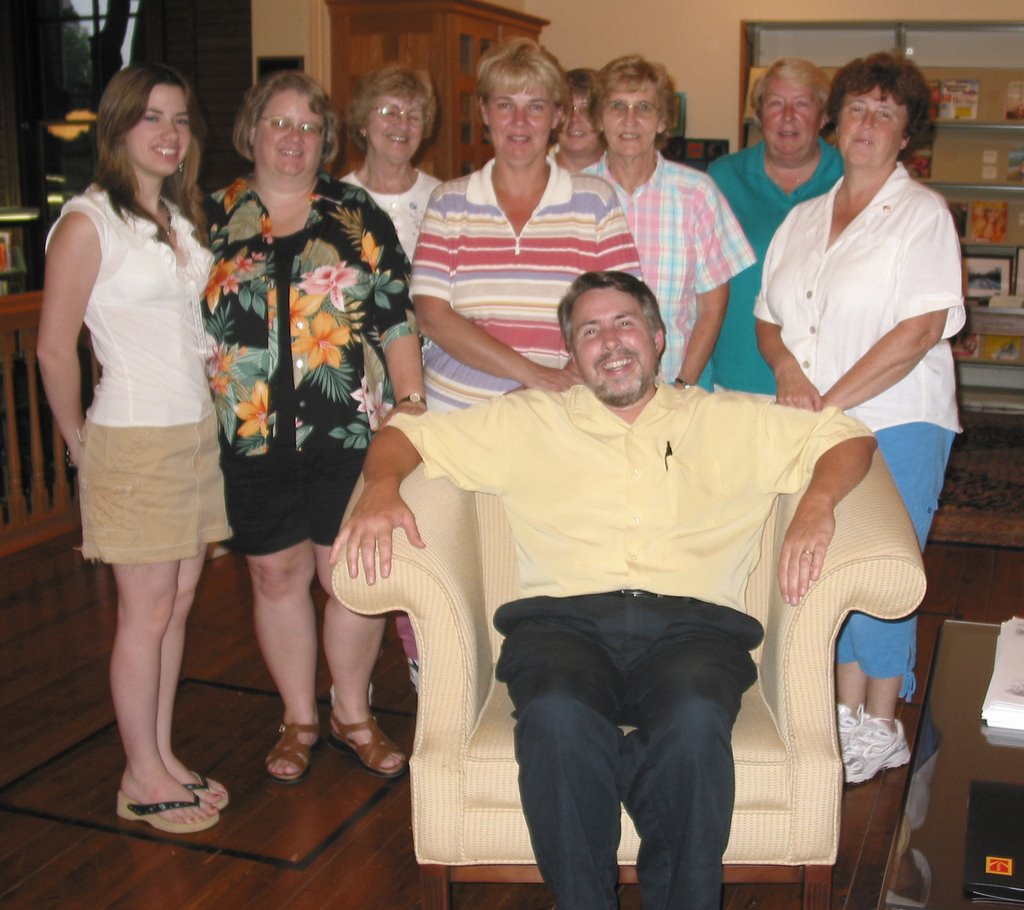
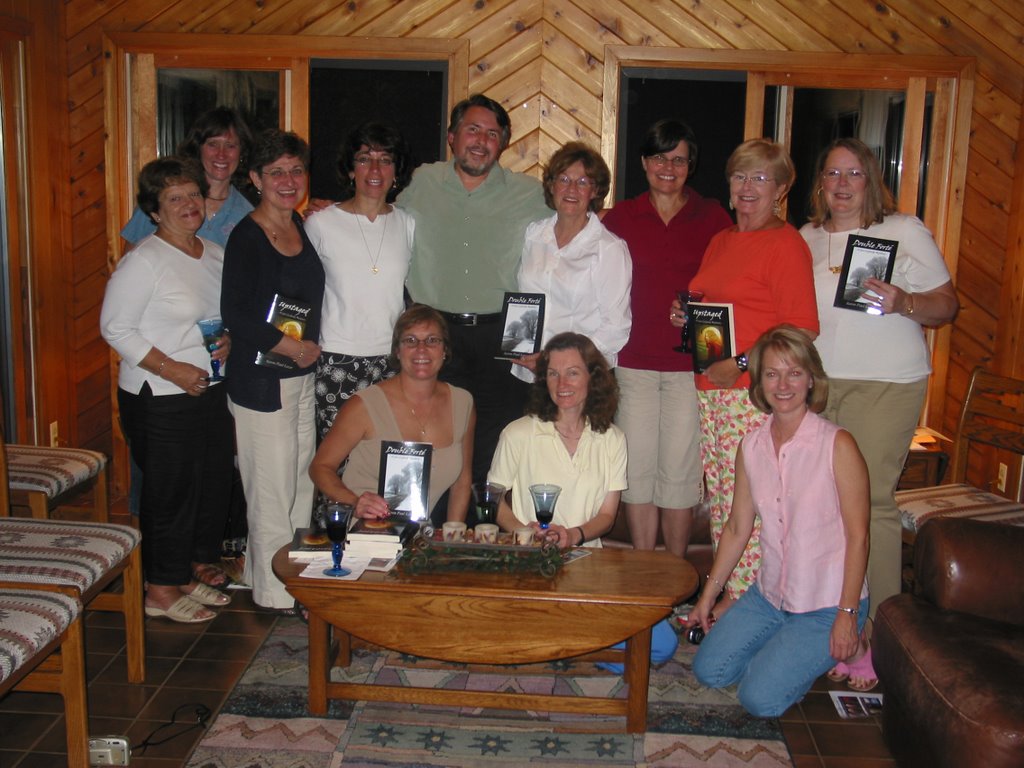
The Oak Ridge Drive Book Club, Sept. 8, 2006

What a lovely evening we had! Great wine, lots of laughs, and connecting with readers. That's what it's all about!


Thursday, September 07, 2006


Who’s that Knocking?

by Aaron Paul Lazar


Living in an antique home has its problems, especially when you’re not a handyman. My father taught me all sorts of wonderful things when he was alive, including passion for the arts, gardening, nature, gourmet cooking, and a good mystery. He didn’t know much about mechanical, plumbing, electric, or woodworking skills. Though I’ve tried to learn over the years with self-help books and advice from friends, I remain singularly unhandy, perpetually bowing with an unholy need to the whims of the local plumber and electrician.

Take, for example, the twenty-six windows that are crumbling as we speak. The six by nine inch panes are coming loose from their wooden mullions with alarming frequency. Or the floorboards in the bedroom, a lovely old yellow pine, that poke up like teepees when it’s hot and muggy. Yeah, they need to be treated with poly something-or-other, but for now, the moisture makes them swell. Consider the two wells that sometimes work in concert – except for the hundred times a year I have to run down to the cobwebbed cellar and reset the breakers or tap on the pump to make it work. The disadvantages are many.

But there are also great benefits, such as the three working fireplaces. Or the soil that surrounds the property, rich and black, untouched by bulldozers. It’s not like the hard packed fill they put in the new housing tracts. I don’t need to “amend” this soil. I just need to keep up with the produce and flowers.

Most intriguing of all, however, is the rich history.

Our house was built in 1811 by Dr. David Hunt.

Okay, so compared to the homes in Europe, it’s just an infant. But in terms of our country and its young age, it’s amazing. Think about it. This house was built and lived in more than fifty years before the civil war!

Imagine the births, deaths, dramas, romances, and heartaches that occurred within these rooms. Did the inhabitants suffer from small pox? Starvation? Were they affluent? How many horses or cows did they own? And… how many ghosts linger in these plaster and lathe walls?

Let’s examine the past 100 years. According to an elderly neighbor, over seven people have died on Hunts Corners. Traffic accidents. Drivers not stopping for the all-way stop signs, or sliding on ice, or drunk drivers plowing right into the telephone pole. Sad to think about. Makes you wonder about their spirits. Did they ascend to Heaven? Or do a few guilty souls remain in the area, confused and wandering, seeking the path to redemption?


Recently, I began to ponder another death disclosed to me by a young neighbor friend. We began to correspond after he read a few of my books. He’s a bright and entertaining young fellow who happens to be a voracious reader. We clicked. And we chat back and forth about books and life and sometimes… about the history of our area.

It seems Hunts Corners has a mystery all its own, stemming from the early 1900s. As the story goes, my young neighbor’s great grandmother noticed something odd one day. (I’ll invent names to “protect the innocent!”) While going about her daily duties, Mabel realized she hadn’t seen the young girl who lived next door in a long time. Anna no longer attended school, and rarely made an appearance outside the home. When she did, Mabel noticed a thickening in her middle, well-wrapped by heavy garments. She suspected the girl was with child. In that era, a pregnancy out of wedlock was unthinkable. Shameful. A sin. The family would endure public humiliation if news got out. So Anna was sequestered for nine long months as Mabel watched the child grow in her belly.

When the time came for the baby to be born, there was no activity in the house. No child was seen. No doctor arrived. All was quiet.

Speculation grew. Was the child stillborn? Or worse, was she murdered by a family cloaked in shame? Rumors were that the little baby was buried behind Anna’s house.
Since then, there have been reports of children pointing behind the house, exclaiming about the “little girl in the weeds.” The adults couldn’t see her.

But I think I might have, last winter.

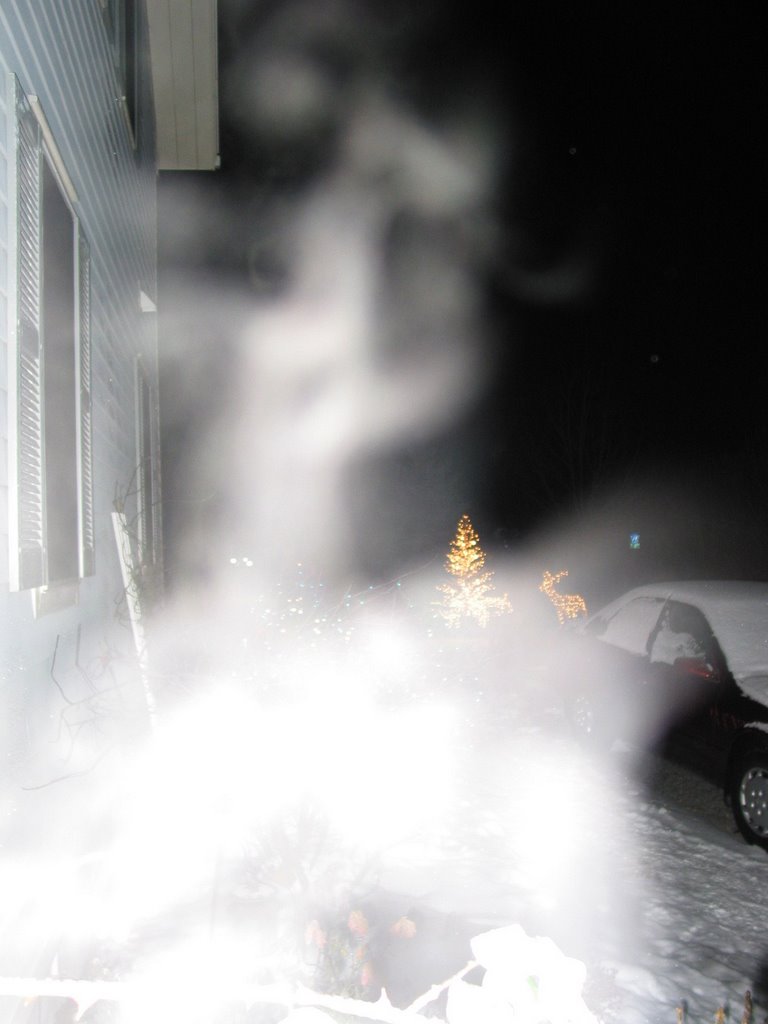
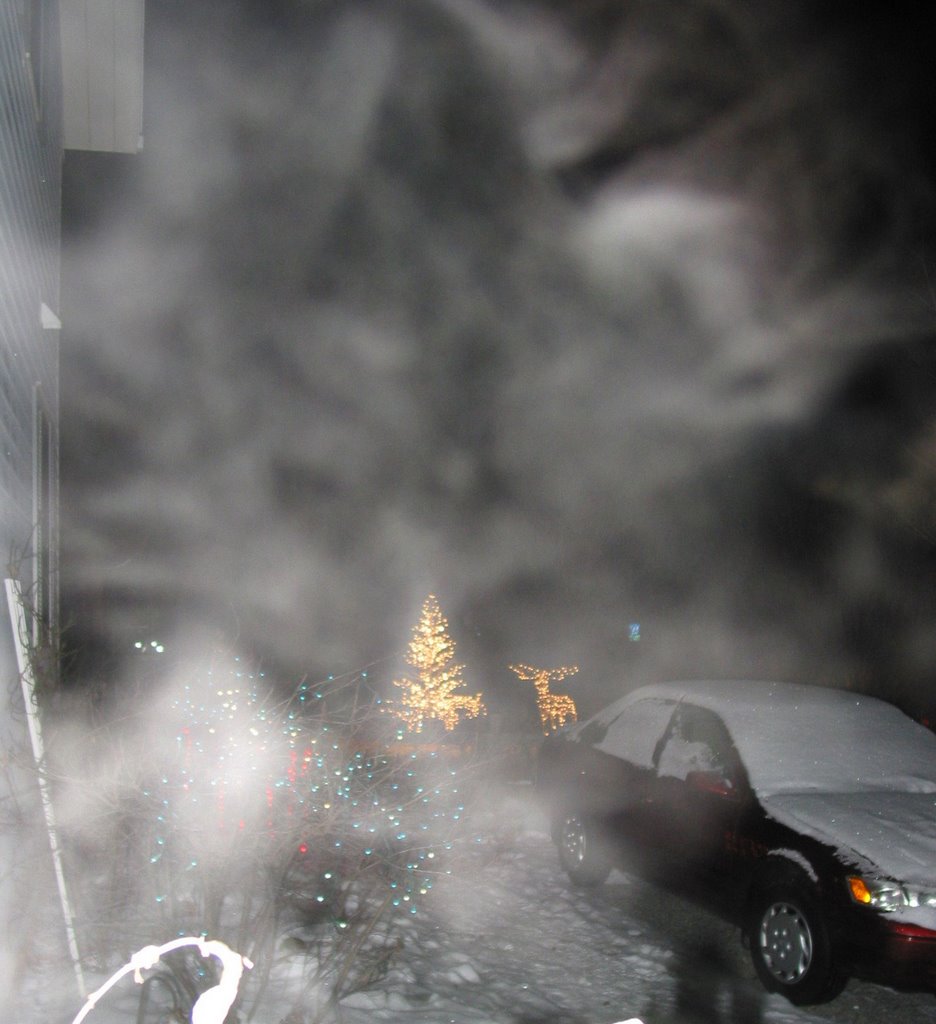
I rose early to photograph our Christmas lights. They were unusually festive last year, better than all past years. We’d added a few lighted deer for fun, and I was bound and determined to capture the beauty in the blackest of night. It was a clear, chill morning. Five A.M. Not a breeze stirred. Most households were fast asleep. Few cars passed by.

I brought my trusty Canon Powershot outdoors and shot dozens of photos. Later, when I viewed them on my PC, I saw the ghost. There she was – looking straight at me with wide open eyes. Filmy, transparent, but with a clear face and body. Only two shots revealed her, although I took dozens that morning.


The photos are untouched, straight from the camera card. And yes, I know there’s probably a scientific explanation. Maybe the light from the flash illuminated ice crystals in the air, causing a momentary illusion. But I’d like to ignore that for now and just consider it a visit from my friendly little ghost.

Last night I woke to a tapping sound. Usually it’s Max, on his chair, scratching an itch and thumping up against the armrest. I rose to check, but he lay still, mouth open, breathing evenly.

Could it be my grandson knocking on the door? I looked. No one was there. All was quiet, no little boys or cats were hoping to gain entrance.

I went back to bed. The tapping resumed. Looking out the window, I noticed headlights flashing by, briefly illuminating the darkness. Was that a flash of white? A face? Or simply the reflection on wet streets?

The tapping resumed. Outside my window. On the second floor.

Could it be?

I buried my head beneath the covers and said my prayers.

Friday, September 01, 2006


Savor the Moment: inspiration for writers

by Aaron Paul Lazar
August 31, 2006


It’s the last day of August. Autumn has already stretched tentative tendrils toward us, cooling the evenings and drenching the morning with heavy dew. Today, as I rounded the top of a hill overlooking the valley, my breath caught in my throat. Before me lay the snaking path of the Genesee River, previously hidden from casual view behind fields and woods. Nebulous clouds of fog hovered above, revealing the river route that quietly meanders out of sight most of the year.

My soul exploded with a sensation of splendor best described by the Japanese philosophy, wabi sabi*. This was a wabi sabi moment – a fraction of time linking nature and man, steeped in intense sensual beauty…so full of wonder it transports you to a moment of spiritual enlightenment.

In addition to the vapor-bound river, the countryside was punctuated with farmers’ ponds, exposed via banks of fog steaming overhead. Normally hidden by tall fields of grass or corn, the wisps of moisture called attention to the quiet shallows, home to frogs and watering holes for livestock.

Stunned by the beauty, invigorated beyond belief, I continued on the drive that I’d taken thousands of times before. Heading north on River Road, whispers of “Thank you, God,” floated in my brain. Still and amorphous, the words vibrated in syncopation with stirring grasses.

Once again, nature presented a feast so lovely I choked with emotion. There, to the east, clusters of wheat waved in the sunlight with heavy heads bowed under the weight of soaking dew, their curvatures swan-like as they moved in glistening silence.

The ephemeral nature of this phenomenon is part of the allure. That precise moment of intense immersion, that amazing connection with nature, will never repeat. The suns rays may not hit the grass with exactly the same angle or intensity. The grass will change tomorrow, perhaps drier, taller, or shorn. This transient moment of staggering beauty must be absorbed and cherished.

What path do writers take to experience this? How do they open the channels in the brain that might have been content to listen to Haydn’s 19th Symphony in C Major, but blind to nature’s offerings? (this was playing on the radio when I delighted in these visions today.)

First of all, one must be a “visualist.” That isn’t a real word, but it describes what I mean. A person who is stunned by physical natural beauty (certainly not at the exclusion of aural, tactile, or emotional stimulate) possesses visual aqueducts to the world through his or her eyes. Infinitesimal flashes of stunning images move him beyond belief. These impressions are captured in his mind’s eye, never to be lost, forever to be savored. And often, when this type of writer is creating, they see the “movie in their mind,” pressing from within, allowing readers to feel intimate and involved in a scene.

What type of a reader are you? Do you soak up scenes written by others? Imagine them for days on end? Find choice gems of passages that affect you for life? Do you want your readers to feel this way about your own prose?

It is this deeply felt appreciation for nature, for life, for wonder, that promotes a good writer to potential majesty. Perhaps not to best-seller status – that illusory fate is in the hands of a publishing industry often not tuned into art, but focused solely on profit. Try to ignore that aspect when you are creating your next masterpiece. In time, if the stars are aligned and you achieve this pinnacle of greatness, it may happen.

Open your eyes. Reel it in. Absorb the beauty around you, whether it is the flash of love in an old woman’s eye, or the fragile petal of a tiny orange cinquefoil. Allow yourself to be in that moment, record it in your soul, and play it back for your readers for the ultimate connection.

You can do it. Just try. And send me what you’ve written. I’d love to see it!


* Wabi Sabi for Writers, by Richard Powell, Adams Media.

Thursday, August 31, 2006


On yesterday's lunch walk, we found this poor Monarch butterfly. We said a prayer for it's fragile soul after exclaiming over its beauty. Note the symmetry of the rectangular patches and the spots on the body itself. According to my friend John C, the double layer of white dots along the edge differentiate it from the Viceroy butterfly, which looks similar but has only one row of white spots. He also explained that the Monarch's feed on milkweed and taste bitter to the birds, whereas the Viceroy's feast on sweeter meals, providing a more tempting treat to their aviary adversaries!
Thanks to Linda Slade for permission to use the photos.

Monday, August 28, 2006


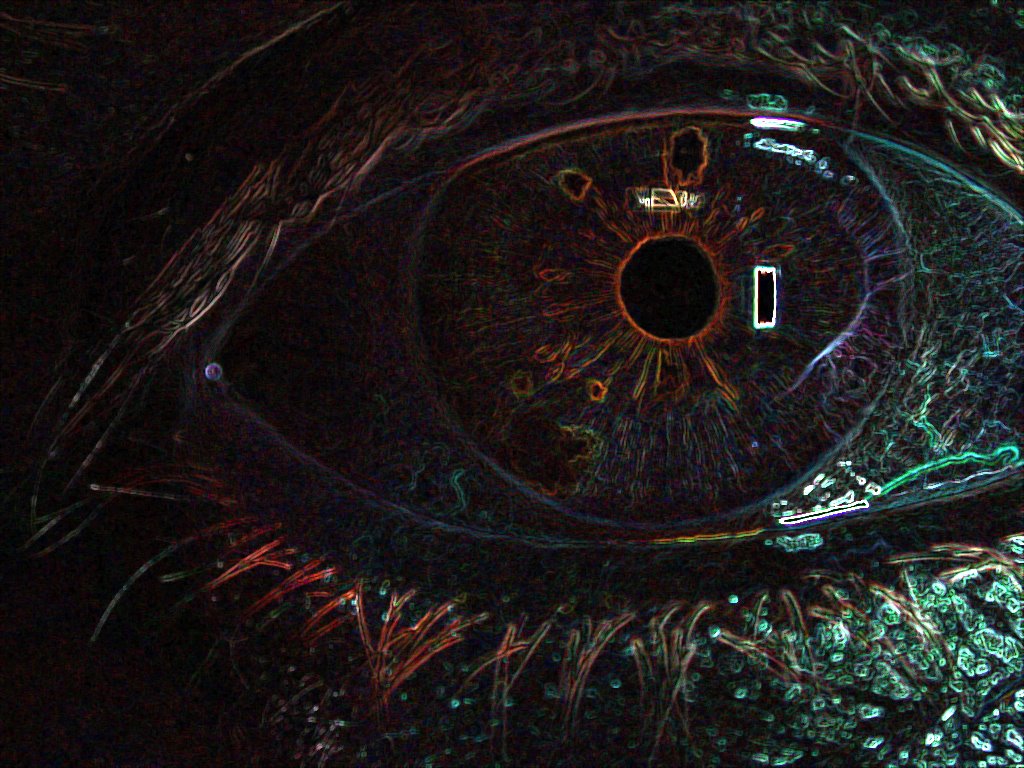
The Author's Eye, Original Photo

Just for grins, here's the original digital photo that I used to create the photoshopped version, below.

Thursday, August 24, 2006


The Author's Eye


More Advice for Writers – Forbidden Words

by Aaron Paul Lazar


I’ve collected some great writing advice over the past years. Some of it has worked, and some hasn’t. Recently, however, the list of “forbidden” words has grown through advice from fellow writers, agents, editors, and publishers.

It can be paralyzing.

Every time I bump against “that” or “had” in my prose, my heart beats wildly and I worry. “Does this belong here? Does it make my work sound amateurish?”

It’s almost impossible to avoid the words on the list. You can’t completely eliminate them. It’s especially true with dialogue. You want your characters to sound as natural as possible.

Let’s examine the first word on the list: down.

Now, in most cases it’s far superior to write, “Horatio sat at the kitchen table and stared at the congealed eggs on his plate,” rather than “Horatio sat down at the kitchen table and stared down at the eggs on his plate.” Right? And this rule of thumb is excellent, almost universally applicable. It also works for the word, “up.” In America, we use “up,” all the time in natural conversation. “Bubba ate up all of Cat’s french fries.” “Nancy stared up at the ceiling, searching for the right word.” “Sonja messed up Veronica’s hair and then jumped overboard.” And so on. Okay, these are crazy examples, but you get the point. You could certainly eliminate some of those “ups,” right? But be careful not to eliminate it in your characters’ dialogue. You don’t want them to sound stilted. It’s perfectly okay to use common phrases such as, “Margaret, get down here! Your toast is up.”

One of the first pieces of advice given to me (aside from “Cut, cut, cut!”) was to avoid the use of gerunds and “ing” verbs. “It’s much stronger,” I was told, “to use the simple past tense, or ‘ed’ verbs.” So, like a good doobie, I went back through my first four books and scoured them for “ing”s. I was merciless. Brutal. Barely an “ing” survived.

A few years later, I realized I went too far. The words sounded robotic, too stilted. I needed some of those “ing” verbs to vary the rhythm of the sentences, to make them sound more natural. So, with diligence, I returned to my growing list of novels and revamped them. Now, keep in mind it’s always better to write, “Mabel watched the plane land,” than “Mabel was watching the plane land.”

All right. What about tenses? We all learned the proper way to conjugate verbs and use tenses, such as the case of the past perfect. When something happens in the past, such as a flashback, it’s taking place before the current action, which is already in the past tense. Therefore, the flashback needs to be cast into the past perfect, using the word “had.”

Right?

Not always. My crit buddy SW Vaughn taught me this one. (many of the following examples are courtesy of her patient teaching.)
It is grammatically correct to write the following paragraph when referring to a recapped an event in your story:

A pang of sorrow hit me as I thought back to the dreadful time two years ago when I had lost him. He had fought the cancer as bravely as he had stood up to the Germans on D Day in Normandy. Just before we had learned the dreaded disease had returned to claim him, we had shared one final, peaceful day of fishing on Hemlock Lake. (granted, I would have made most of these contractions to make it sound more natural.)


However, it reads smoother like this:


A pang of sorrow hit me as I thought back to the dreadful time two years ago when I lost him. He fought the cancer as bravely as he stood up to the Germans on D Day in Normandy. Just before we learned the dreaded disease had returned to claim him, we shared one final, peaceful day of fishing on Hemlock Lake.


I’ll admit, now I would be tempted to remove the “up” and would probably rewrite this passage with a vengeance. But can you see how just one or two well-placed “hads” retain the meaning of the memory? Of course, there’s always the opposite viewpoint. My current editor added a number of “hads” in my manuscript for Tremolo because I went too far!

Next came the great adverb purge. I don’t remember which book it was that got me going on this kick. Probably Stephen King’s, On Writing. (That was a great read!) Regardless of the source, I was inspired to eradicate adverbs. I became an adverb Nazi. No “ly’s” would sully my prose! I’d search for the choicest verbs. They’d glow from my pages because of their utter perfection. After that phase, I backed off a little, allowing a few adverbs here and there. Sometimes, it just sounds better with them, doesn’t it?

It’s all a matter of balance.

Let’s talk about the word, “then.” I have to admit, it’s prevalent in my work. My characters are always doing something, “then” going onto the next action. I liked it instead of “and.” It seemed to fit better and sounded more natural to me.

This year, while participating in an online writers’ critique forum, I was surprised to learn when these editors spotted the word “then,” or too many instances of “as” or even a “suddenly,” they immediately pronounced it amateurish and went to the next piece in the slush pile.

How did I react? Did I sit back and judiciously cull words from my books? Or did I throw my hands in the air (notice I didn’t say “up in the air!”) and give up? (okay, so I used up here.)

Still aching to learn the “rules” that would graduate me to “professional writer status,” I dutifully reduced the number of the “then’s” and “suddenly’s” from my current work in progress. They read better. I think…

Sometimes I end up using different “forbidden” words when I do this. It’s so frustrating, and it can be almost crippling if you let it. Although I’ll never stop trying to improve my prose, I’ve decided that I need to just “let it out” in the first draft, and then (LOL), review it in future edits to purge the evil words.

Here’s a handy list of words to keep in mind when editing:

1) “Down” and “Up” may be eliminated most of the time. “Oscar set his fork down on his plate and nodded in the direction of Conaroga,” could better be worded. “Oscar set his fork on his plate and nodded in the direction of Conaroga.” Or: “The heat wave sizzled throughout the week, drying up the cornfields to the point of near desiccation,” is better without the word, “up.” The heat wave sizzled throughout the week, drying the cornfields to the point of near desiccation.

2) Examine verbs ending in “ing,” especially in conjunction with “was” and “were.” Sprinkle them into your writing to vary the rhythm, but avoid cases such as “I was watching the birds while drumming my fingers on the table.” You might consider, “Watching the birds, I drummed my fingers on the table,” or, “I watched the birds, drumming my fingers on the table,” or, “I watched the birds and drummed my fingers on the table.”

3) Had – use sparingly to clarify the time sequence. Don’t pepper your back-stories with “hads,” and use contractions to make it sound more natural. “All four teeth had finally broken through and the poor baby was finally out of pain.” Try something like this, instead: “All four teeth finally broke through and the poor baby was finally out of pain.”

4) Remove unnecessary adverbs. Change sentences such as “Judy looked sullenly at me,” to something like, “Judy glowered at me.”

5) Eliminate the word “the” when it precedes a noun that could stand alone. Example: “The images from the newscast whipped across my brain,” might be replaced by “Images from the newscast whipped across my brain.”

6) Minimize contiguous prepositions, and words like “over” and “back.” “Mary threw the ball back over to Tom.” Instead, “Mary threw the ball to Tom,” or “Mary returned the ball with a vengeance.” Avoid sentences like “The boy ran over to the counter,” or “I trotted back along the trail.”

7) Steer clear of “that,” except in dialogue. We use “that” as a connecting word far too often, and we don’t need it! I’ve already removed a number of “that’s from this article. It really does smooth out the prose. Try it! “The President discovered that his agent was a spy.” Instead, “The President discovered his agent was a spy.”

8) “Suddenly” was just added to my list. I used it interchangeably with “Without warning,” “Instantly,” or “In seconds.” I am still confused about the legitimacy of this one. A good friend whose manuscript is currently being scoured by her editor said she’d removed all instances of “suddenly,” only to have her editor put them back in!

9) Another word we use a lot in conversation is “very.” Try not to use it in prose. Find a better descriptor. “The giant was very tall,” is better as, “The giant towered over us.”

10) Because can be used sparingly, but not in the following way: “She craved the hamburger because she was hungry.” This example might work: “Because of his history, he avoided the cops.”

11) Minimize your use of “then,” and “as.” “He must have crawled into the trash barrel to look for food or water and then became trapped in its slippery interior.” Instead, try: “He must have crawled into the trash barrel to look for food or water and become trapped in its slippery interior.” “His eyes shone as he sat on the front seat,” might be replaced by “He sat on the front seat, eyes shining.”

12) Avoid phrases such as, “I saw,” “I felt,” “I heard,” or even worse, “I could hear,” “I could feel,” or “I could hear.” Instead, try to show precisely what is happening through the sounds or visions. For example: “I could see the hawks flying overhead, swooping in lazy circles as they sought fresh blood.” Try replacing it with something more direct, like this: “The hawks swooped in lazy circles overhead, seeking fresh blood.”13) I don’t care for the word, “which.” A friend, Jude, just reminded me to add this to the list. Here’s his example of an awkward sounding sentence: “I put ice on her ankle, which had already started to swell.” Perhaps a better solution might be, “I applied ice to her swollen ankle.”

13) Shun clichés like the plague. Whoops. ;o) Seriously, though, clichés are just that – timeworn and boring. Create something scintillating!

14) Try not to repeat words within a chapter. For example, if you’re describing an explosion, be sure to vary the words that refer to it, such as “the blast,” “the roar,” “the eruption,” or “the detonation.” Remember, http://www.thesaurus.com/ is your friend!

If you’re totally confused by now, join the club. This whole thing can be daunting. But don’t be concerned if any of the “forbidden” words pepper your prose. Take heart. As you’ll see from similar studies, many of the classics and current bestsellers are fraught with these words. Does it matter? Heck, no. We still enjoy the books as readers will for years to come.

Consider what the wabi sabi philosophy teaches us, “Nothing is perfect. Nothing lasts. And nothing is finished.” (Richard R. Powell, Wabi Sabi for Writers, 2006, Adams Media, ISBN 1-59337-596-4)

My advice? Don’t go crazy each time you learn a new forbidden word or phrase. Simply do the best you can, write from your heart, and try to tighten your prose without squelching your own style.



***


Aaron Paul Lazar is an engineer by day, but his passion lies in writing. The LeGarde Mystery series involves more than breathless suspense -- the books are filled with musical, lyrical scenes that touch on life, loss, nature, family, animals, food, gardens, and music. Eight books have been completed. A second series has also been born, featuring paranormal mysteries with Sam and Rachel Moore, a retired country doctor and his wife who suffers from multiple sclerosis. Lazar’s latest book, Tremolo: cry of the loon, is available through Twilight Times Books.

Mr. Lazar also writes monthly columns for the Futures Mystery Anthology Magazine, Voice in the Dark newsletter, and The Back Room ezine. He lives in Upstate NY with his extended family. Visit his websites at http://www.legardemysteries.com/; http://www.mooremysteries.com/, and his blog at http://www.aaronlazar.blogspot.com/.


Wednesday, August 23, 2006


Another lovely day for a walk in
Upstate NY...


Monday, August 21, 2006


What’s in Your Back Yard?
by Aaron Paul Lazar


I’ve had some interesting “lunch walk” partners over the years. When I started engineering at Kodak twenty-five years ago, I found friends who shared my lust for the outdoors – who longed for fresh breezes and blue sky – and who longed to break out of the gray enclave and burst into sunlight in the middle of the workday. We walked regularly, usually for three miles around the perimeter of the dozen buildings that sprawled in a massive complex.

There was Gangaram, my Gujarati friend, who stomped over the grass with certainty, expostulating about family and tradition, and sharing stories of his exotic and colorful childhood in India. He died of a heart attack, fourteen years ago. I still think of him fondly and often recall our deep discussions of fatherhood.

Next came Dave, a true kindred spirit, whose life seemed to parallel mine in the realms of children and reading. Dave’s four daughters were ten years ahead of my three girls, and I learned many lessons in the virtues of patience and quiet endurance during our walks together. He introduced me to Clive Cussler’s Dirk Pitt novels. Dave is retired and now boasts thirteen (or is it fourteen?) grandchildren.

I became attached to my walking buddies over the years. Friendships blossomed and our lives were enriched.

Then, there were the years when I walked alone.

I’ll never forget those walks in the fall of 1997, just after I lost my father. I strode through crunchy leaves and listened to the leaves whispering my name, longing for signs that Dad was okay… that I was okay. Well, I wasn’t. But in time, I forged on and learned to cope with the most powerful loss of my life.

I wrote God-awful poetry after those walks, redolent with lush imagery and emotion that spilled from the pages. Although it wasn’t suitable to publish, it did get my career as a writer kick-started. Soon afterwards, the LeGarde Mystery series was born and it’s still going strong, nine years later.

This year, my lunch walking pal left the company for greener pastures. She landed a sweet job in another state, with a collection of low-cost benefits that are otherworldly-amazing. She’s started her own solo lunch walks around her new complex. Soon, she’ll align with new friends who have the same need to escape to nature for a short while. I accept that this cycle repeats and wish her great success in her new adventures.

In twenty-five years of lunch walks, however, I never knew what lay in my own back yard.

My new walking buddies are adventurous. I call them the Treasure Hunter and the Meanderer. They don’t settle for the same old paths over which I’ve trod for years. They cross the street, duck down barely visible dirt paths, and venture into lands outside the complex. Through these brave pioneering marches into foreign territories, we’ve discovered a lunch walkers’ nirvana.

There, just across the street and not fifty feet from our usual perimeter walk, lay hidden trails that lead to glorious glens, sparkling creeks, and grassy trails lined with woods. For twenty-five years - nearly a thousand walks - I’ve passed this seemingly scrubby area and not given it another thought.

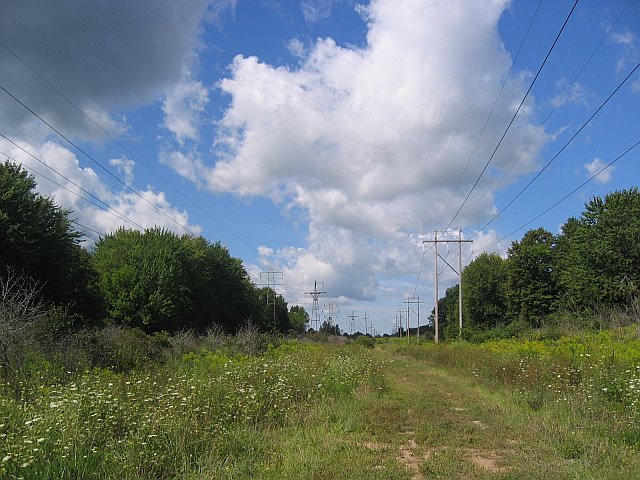
Until last week, when on one of the far-flung adventures, the Meanderer led us to some newly discovered wood trails. I remember the day well. That evening, I was scheduled for a book club event at 6:30 in a nearby library. We passed through cool, glorious woods and broke into the sunlight to follow a dirt track flanked by robotic-looking power lines. Delighted to find such previously hidden treasures, we chatted and laughed our way through patches of Queen Anne’s Lace, purple loosestrife, buttercups, black-eyed Susans, and flowering milkweed. Heading in the direction we hoped was “home,” we stumbled upon a wide creek. The Treasure Hunter pointed out a blue heron taking flight.

In the distance, we heard the sounds of humanity. A metal door clanged shut in a company loading dock. Cars whooshed past on the road we’d originally braved and crossed. We were heading in the right direction.

After tromping through the “wild,” sweaty and tired and ready for the sandwiches that beckoned in the bags on our desks, we had to find a way across the creek. We began to inspect the shore, walking farther down the muddy stream. Although we hoped to find a crossing or a narrow neck of water, we were sunk. There was no way to cross.

Unless…

Our pioneering spirits kicked into overdrive as we searched the nearby woods for dead limbs or tree trunks light enough to carry, but heavy enough to hold our weight. The Meanderer found a balancing pole. I threw the gathered logs across the creek, splattering my blue Dockers with fresh mud. Laughing and feeling deliriously adventurous, I ventured out over the logs.

I set one foot on the slippery log. It sunk into the mud, moistening my walking sneakers. Using the balancing pole, I cat-walked across the creek – until I came to the end of the man made “bridge,” where the grass-filled water looked solid from the opposite bank. Stuck, I forged ahead, sinking up to my ankles in mud.

The tears rolled down our cheeks as we belly laughed, choking and guffawing until we thought we’d lose control. There are no restrooms in newly discovered nirvana. Doubled over and nearly hysterical, we finally stopped to assess the situation.

More logs seemed to solve the problem. I caught and positioned them so my friends could safely avoid the muck.

The Meanderer started across, using the balancing pole carefully. One step. Two.

She’s gonna make it!

Three. Four.

Five, six, seven.

Oops.

On the last step, she lost her balance and stepped into the gooey mess.

Another round of insane laughter. This time, the Treasure Hunter took a turn. Confident she could navigate this last hurdle, she took one step, lost her balance, and another sneaker was submerged in guck.

Laughing uncontrollably, we sloshed back to work, leaving muddy trails of pond scum in our wake. I tried to clean off my pants, but was only partially successful. The sneakers went into a plastic bag, and I stopped on the way to the book club appearance to buy a fresh pair of socks.
Now, we head for the trails at every opportunity. Yesterday, we brought a lunch and read aloud in a cool glen. And still, I remain astounded that this amazing oasis lay undiscovered, in our proverbial back yard, for the past twenty-five years.

What lies in your back yard? Are there trails, unexplored, that call to you? What waits on your bookshelf, or in your attic? Are there books, unread, that whisper your name, that could forever change the way you see life? And for you writers, are there stories untold, visions still clouded, that may become your next work of art?

Search beyond your comfort zone. Cross that street, delve into those woods. Open that book. Discover what’s in your own back yard. Today.

Wednesday, August 16, 2006

New Release! Click here to buy the ebook in downloadable pdf format until the print version is released in 2007.


Tremolo: cry of the loon, is a coming-of-age mystery, a stirring and nostalgic trip back to the summer of 1964 when the nation mourned the assassination of JFK and American life was forever changed by the arrival of the Beatles.

Eleven-year-old Gus LeGarde is spending another glorious summer at his grandparents’ lakeside camp, along with his best friends, Elsbeth and Siegfried Marggrander. When their boat capsizes, Gus and the twins witness a drunk chasing a girl through the foggy Maine woods. She’s scared. She’s hurt. And she disappears.

On horseback and on foot, Gus, Elsbeth, and Siegfried search for Sharon Adamski, worried her brutal father will find her before they do.

During the hunt, Gus is faced with a number of personal dilemmas. He must keep secret his new friendship with “Mrs. Jones,” a woman in mourning who resides incognito. Gus also glimpses a slice of the twins’ life through their mother, who lost her family in a Nazi concentration camp. In a cruel coincidence, Gus faces the imminent loss of his own mother.

Reports of stolen religious artifacts reach the lakeside camp. New England churches have been ransacked, and missing is the church bell cast by Paul Revere, stolen from St. Stephen’s church in Boston’s North End. When Gus and his friends stumble on a scepter that may be part of the loot, they become targets. The villain turns on them, and all thoughts of a lazy summer whirl out of control.

Tuesday, August 15, 2006


Women of Wheatland Book Club, August 14th, 2006. We enjoyed an enchanted evening filled with laughter and deep discussion.

Connecting with readers is what it's all about. Meeting with book clubs is a hidden aspect of writing that offers unanticipated joy. I simply love it.

To see future events click here.

Friday, August 11, 2006


Here's a nice shot of a bumblebee , taken by friend Linda Slade, copyright 2006, used with permission.


Ever seen a "clear winged hummingbird moth?" Isn't it cool? I have these all over my tall garden phlox this time of year. This little guy was captured by friend Linda Slade, copyright 2006, used with permission.


Tuesday, August 08, 2006

I heaved a great sigh of relief this weekend after completing two major events.

First of all, I finished the draft for One Potato, Blue Potato, the second book in the new Sam Moore paranormal mystery series (www.mooremysteries.com). It's immensely satisfying to finish a project like that. It's my tenth book. For some reason, however, I always feel a surprising sense of loss when I type "The End." Do other writers experience this same emotional plunge? I'd love to hear from you writers out there.

Also, I completed the review of my editor's comments for Tremolo: Cry of the Loon, the third Gus LeGarde book. It will be published under the Paladin Timeless Imprint of Twilight Times Books. (Twilight Times Books is one of the top twenty publishers according to the Preditors and Editors™ 2005, a reader's annual survey of the best on the web. In addition, Twilight Times authors, artists and editors made the top twenty in several categories.)

Tremolo is a coming-of-age novel, a "literary mystery," set in the Belgrade Lakes of Maine. It's a stirring and nostalgic trip back to the summer of 1964 following President Kennedy's assassination and during the invasion of the Beatles. This is the first opportunity to meet the brilliant young Siegfried before the accident that incapacitates him. Readers will also meet Elsbeth as a child. She's fiery, adorable, and alive in this book! Gus experiences his first crush on an older "woman," deals with jealousy when he learns of the potential birth of a new sibling, and befriends a mourning, mysterious high profile guest. Gus and the twins search for a missing girl, Sharon Adamski, whom they witnessed being chased by a drunk in the foggy woods. And who is stealing religious artifact thefts from New England churches? When the villain turns on them, the anticipated lazy summer whirls out of control. (Scheduled for ebook release August 15 - September 15, 2006 and in print form summer, 2007.)

I've also updated the award winning LeGarde Mysteries website with plenty of new photos, music, and links. You'll find pictures from book clubs and signings, a new excerpt from Tremelo, and three new photo galleries filled with images of lakes, skyscapes, and winter in the Genesee Valley. This month the website was honored to receive the August 2006 Myshelf.com's website award!

The Recommended Reading page has new offerings on it, complete with reviews.

And check out the Seedlings section - there's plenty of free fiction from the monthly column that will debut in its third forum in September 2006. If you have a moment, visit Anne K. Edwards' Mysteryfiction.net. Her newsletter, Voice in the Dark, includes pieces by some wonderful authors, including Lad Moore. "Voice" is a comprehensive newsletter for literature lovers, including readers and writers. Seedlings also runs monthly at Bob Burdick's The Back Room and in the Futures Mystery Anthology Magazine.

For the writers on distribution, take a look at Nadia Brown's new website for author and book promotion: http://www.freewebs.com/authorpromotion/

There are currently six great LeGarde events scheduled in Upstate NY in the next few months. If you happen to be in the neighborhood, please stop by a Reading or a Winery Book Signing. See the Events page for details.

Before I go, I'd like to share a story with you. This summer I ended up with a bit of extra space in the garden. About a forty by forty foot patch, actually! I discovered some "volunteer" seedlings growing near last year's pumpkin patch, so I figured, "Why not save them?" I transplanted about 30 of those little guys into the "extra" space. They took off like gangbusters, filling the space immediately. When I returned from vacation, I found that most of this new patch was filled with squash plants! Summer squash, goldrush, zucchini, MiddleEaster cousa, acorn... you name it! Now, you must realize, I already planted 18 hills of squash on purpose! Needless to say, I've been bringing bagloads of all kinds of mixed hybrid squash to my friends and neighbors for weeks now. It's fun - and is keeping me in shape!

Warmest regards,

Aaron Paul Lazar


Friday, August 04, 2006

Genesee Valley Ridge & Conesus Lake
Early morning


Just One of Those Mornings
by Aaron Paul Lazar

It was just one of those mornings.

The day started out fine. I slept well and woke at 4:30 to email a fellow author who’s ghostwriting a book on The Power of Positive Thinking. I’d promised a few examples of my own philosophy. You know, the kind of stuff that is infused with optimism and oozes rhapsodic enthusiasm?

The email was more of a treatise on coping mechanisms, or “How to be happy when the world around you crumbles.” I recommend “taking pleasure in the little things” and cited some examples that have helped me in the past, such as soaking in the sunrise or absorbing the winter beauty of a wheat field glistening with ice. If all else fails, I list the things for which I should be thankful, such as: “At least I’m not lying in a ditch in Iraq like our poor, brave soldiers,” or “I’m not riddled with cancer.”

I know. It sounds downright naive. I’ve been called a male “Pollyanna,” before. But heck, it gets me through those tough times and… it actually works!

After writing, I showered, made my lunch, kissed my grandsons goodbye, and slipped into my parka. I fumbled around for my car keys. They were missing! I shrugged, decided to solve the mystery later, and grabbed the spare set. I ventured out into blackness of the early morning and headed for the car. The lights didn’t come on when I opened the door. A sinking feeling settled in my gut. There were my keys, dangling in the ignition, turned to the “ACC” position!

Daughter #3, home from college for Thanksgiving, retrieved something from the van and apparently turned on the key for some mysterious reason. There they’d remained over the long weekend.

I rummaged around the barn and found a set of cables. Next, I ran back to the car, grabbed a spare key for my mother-in-law’s car, and nosed it into position. In the pitch dark, I felt around for the hood release on my van. Where was that darned lever? I couldn’t find it. I grabbed the flashlight that had been smugly waiting for such an emergency in its holder since last Christmas, and searched again. There was NO latch!

Against every fiber in my being, I admitted that I needed to read the blasted manual. I found it after scrabbling around in the glove compartment. The print was tiny – I needed my cheapo drugstore reading glasses. I keep a pair on my bedside table and at work. I sighed, then remembered a rogue pair that was tucked inside my jacket pocket from my last book signing.

For the next five minutes, I flipped through the deceptive “easy owner’s guide” until I finally found a diagram of the car. There was a hood release, but it looked like it was on the seat bottom. I got on my knees again and searched. I pushed and prodded and pulled everything in sight. I scrutinized the diagram again with fingers covered in grease. Wait a minute! Did I read the diagram wrong? Maybe it’s on the lower left side near the gas tank lever! I dropped to my knees again. There it was, hidden around the corner so that I had to crane my neck inside the car to actually see it.

Good for deterring car thieves; bad for stupid new van owners.

The hood was up. I hooked up one side of the batteries. Red to positive, black to negative. The cables wouldn’t stretch from battery to battery. I needed another measly inch. I sighed, got in the other car, backed it up, and nosed it in closer. So close, that my riotous rose bush caught me each time I squeezed past it. Finally, it was done. The van roared to life.

But alas, it wasn’t over.

Breathe. Just breathe.

The radio flashed the word, “Code” and the clock was blank. A faint memory tickled in my brain… the security system! The salesman gave me a card with a code on it. Where had I stashed it? There it was, in my wallet. The only problem was, I couldn’t read the fine print. I patted my pocket for my glasses. They weren’t there. No, they were stuck on my peanut butter toast. I cleaned them off, reset the code, and headed to work.

I grumbled. Then the sun started to rise. The sun kissed the undersides of clouds that glowed gold, gray, and lavender on the horizon. As I drove north, the rays reached higher, splitting the pale pink fingers of dawn.

I started to feel good again, optimistic about the day, and actually looked forward to reconnecting with my colleagues at work. Then I spied the railroad crossing. I was already late for work, and prayed that I’d get across without having to stop.

The lights flashed and the guardrails came down. I put the car in park and laughed at myself. Out loud. It was a belly laugh. And it felt great.

Ah, the power of positive thinking.

Now, how do I reset that infernal dash clock?

Thursday, August 03, 2006

Geneseo "Ladies" Book Club Visit

Hello, friends!

I can't believe how long it's been since I added to this blog. Life has been a whirlwind lately, especially with book club visits, signings, moving my daughter's apartment, keeping up with my massive garden, babysitting my sweet little grandsons, and zooming toward the finish line for the second book in my new paranormal mystery series, entitled One Potato, Blue Potato.

Books are stacking up even higher in my virtual and physical read piles, weeds have been steadily growing in the soggy mulch of the flowerbeds (it's been tropical up here for the whole summer!), and I almost missed my deadline for the Seedlings column.

It's time to dig in, get organized, and try to catch up. In the meantime, hope you enjoy the rest of your summer and discover some gems to read.

Regards,
Aaron

Tuesday, June 20, 2006

Title: Tailwind: Days of Cottonmouths and Cotton Candy
Author: Lad Moore
Publisher: BeWrite Books
Publisher's Address: 363 Badminton Road, Nibley, Bristol,BS37 5JF
ISBN number: 1-904492-02-9
Price: $16.75
Publisher phone number and/or website address: www.bewrite.net


Tailwind: Days of Cottonmouths and Cotton Candy
By Lad Moore
Review by Aaron Paul Lazar
Author of the LeGarde Mystery Series


Tailwind shines with vignettes that drip like pearls of dew, one at a time, to be savored as cool water on a parched tongue. Each story, replete with humor and pathos, transports the reader to the world of rural East Texas in the mid-twentieth century. Mr. Moore’s boyhood was filled with toy soldiers, hot tar on bare feet, fireflies, and shenanigans born of times less electronic, less structured, and certainly less affluent than today.

Imagine sitting around a campfire with a storyteller whose history blazes with events so exotic, so traumatic, and yet so rich that they captivate you with greater intensity than the biggest Hollywood blockbuster. Now, envision the author speaking in a comfortable voice, resonant with humility and humor. This is Lad Moore. This is a writer for all mankind, a universal genius.

Mr. Moore writes with a folksy elegance that is unparalleled in this age. Reminiscent of the great American masters, Tailwind should and will be included as a fundamental part of America’s heritage. The ultimate revelation comes when readers discover that Mr. Moore’s tales are true – stemming from a tumultuous and difficult childhood in which he was abandoned by his mother at six months, barely raised by a glamorous, oft-absent father, and shipped off to military school at the age of eight. Betrayed by his father’s second wife, who stole the family fortune, Mr. Moore suffered poverty with his beloved grandmother, but thankfully was taught of deeper riches via her warm affection and exemplary morality.

Tailwind becomes an extension of one’s being. This reader allowed himself a story every few days – stretching the experience as long as possible, relishing each chapter with nostalgic reverence.

Take for example, the following vignettes:

In “Bologna Sandwich Ceasefires,” young Lad entertains himself with sweetgum armies, creating legions of soldiers from twigs, spent bullet casings, and acorn hulls. Using rubber band missiles, he demolishes entire battalions in an afternoon.

“Cannon fire – sweetgum burs collected in a Mrs. Tucker’s lard can – rained down on the standing forces from the hill above them. Shots fell equally, alternating between the armies, with full sound effects coughed out from deep in my throat. After the barrage, casualty count determined the winner and loser. Soldiers that lost their upright stance from the bombardment must be broken in half – not to be recycled. A mass grave awaited them in the storm sewer.”

In “Nitelites,” young Lad imagines he is a railway signalman, waving firefly “lanterns” in the air as trains rush past in the dark night. He confesses of “smudge pot rolling,” as well.

“…rolling smudge pots was worth it. I could suffer a little tennis-shoe cleanup to see the trail of flaming oil spilling out as the pot rolled down the street. On a good hill, and a skillful roll, I could leave a fireline from Hendry’s store all the way to the underpass. Sometimes a few magnolia leaves would catch fire and add to the excitement.”

In “Solomon of Hardesty Farm,” Mr. Moore describes the enduring friendship of young Lad and an elderly black farmhand in times when racial bigotry was common.

“Old Solomon towered over me like a big tree with his little spectacles hanging from his nose like a pine cone, ready to break free and fall….Like a detour barricade, Solomon stood between the grape rows with his hoe, its handle worn slick and stained by the sweat from his hands. He moved in reverse like the fiddler crab zigging in the aisles of dirt.”

In “New Cars of Short Duration,” Mr. Moore describes the pain of having a callous older brother who wrecked their deceased father’s 1956 Buick almost as soon as he claimed it. Describing the incident, Mr. Moore writes, “It had that strange smell of broken windshield glass – an almost sweet odor – like nutmeg and hot plastic.” When young Lad harbored hopes of owning a car for himself, they were dashed. “My dreams collapsed like a severed elevator.”

Tailwind sings with poetic images of life in small-town America. When one turns the last page, a sense of sorrow descends, akin to bidding farewell to a dear friend. Consolation comes only in the knowledge that Mr. Moore’s second book, Odie Dodie, The Life and Crimes of a Travelin’ Preacher Man, is now available for purchase.

******************************************************************
Lad Moore may be contacted at: pogo@shreve.net. Please place “Tailwind” in the Subject line.

******************************************************************

Aaron Paul Lazar resides in Upstate New York with his wife, three daughters, two grandsons, mother-in-law, dog, and four cats. After writing in the early morning hours, he works as an electrophotographic engineer at Kodak, in Rochester, New York. Additional passions include vegetable, fruit, and flower gardening; preparing large family feasts; photographing his family, gardens, and the breathtakingly beautiful Genesee Valley; cross-country skiing across the rolling hills; playing a distinctly amateur level of piano, and spending “time” with the French Impressionists whenever possible. Although he adored raising his three delightful daughters, Mr. Lazar finds grandfathering his “two little buddies” to be one of the finest experiences of his life.

Double Forté is the founding book of the LeGarde Mystery series and was released in January, 2005. Upstaged, the second, was released in October, 2005. His third, Tremelo: Cry of the Loon, will be released via Twilight Times Books under the Paladin Timeless Imprint in fall, 2006. Mr. Lazar is currently working on his tenth book, One Potato, Blue Potato. He is a regular columnist for FMAM (Futures Mystery Anthology Magazine) and The Back Room, A Cozy Retreat for Writers and Readers. Contact him at: http://us.f387.mail.yahoo.com/ym/Compose?To=Aaron.Lazar@yahoo.com or via his website at http://www.legardemysteries.com/

Friday, June 16, 2006


Coming Home
By Aaron Paul Lazar


The past nine days have propelled me from dizzying heights of joy to the depths of despair. I survived, and thankfully so did my grandson.

A rare new form of strep bacteria invaded Gordie’s baby lungs, aggravating his asthma. He wheezed, coughed, and struggled to breathe. I know what that feels like because I have asthma, too. Unfortunately, I passed on the genes that cause it and am still struggling with the associated guilt.
Gordon is a two-year-old with a sturdy build and curly copper hair. But when he lay inside the oxygen tent in his voluminous hospital gown, he looked frail. Tiny. The moisture coated the inside of the clear plastic walls of his tent and turned his hair into damp ringlets. I couldn’t look at the IV. The bloody spot beneath the layers of gauze made my stomach lurch, and the board they attached to it to keep him from bending his elbow made it worse.

For three days he stayed in the hospital with his parents in attendance, enduring six daily nebulizer treatments, slugs of massive antibiotics through IV, and the dreaded prednisone. Improvement was slow. Finally, after three long days, he came home.

Though still wheezing, Gordie ran from person to person and toy to toy – picking them up and playing as if he’d been away for a year. He jumped onto his tall fuzzy horse and cantered side by side with his three-year-old brother, Julian. He found his beloved turtle, and searched for his dinosaur – the one that looks like George’s dinosaur on “Peppa Pig,” his favorite cartoon. He also picked up a few bad habits - understandably so. When things didn’t go his way, he screamed, “I don wannit!” I chilled to think of the times he must’ve said that to the nurses or doctors who hurt him while working so hard to keep his airways open. The only saving grace is he probably won’t remember the experience. He’s still laboring to breathe, but he’s home now.

This morning I choked up when he woke before the rest of the household and found his way up to my bed. I rubbed his peaches ‘n cream skin with the back of my hand and snuggled with him under the covers, thanking God for his recovery.

While Gordie was in the hospital, I stayed home from work to care for Julian. We visited Gordon and stayed in close touch; thankful he was in good hands. For the next four days, we spent time side by side. My grandsons and I were always very close, even though they’re only two and three years old. But this experience cemented our bond even tighter. Though we worried daily about Gordon throughout this ordeal, we also rejoiced in the gift of time together. My gardening buddy and I spent hours outdoors each day, from early morning until suppertime and sometimes beyond. We planted a forty-foot triple row of onions and mulched beds with oat straw, watching bumblebees buzz around the flowers and listening to the symphonies of birdsongs each morning. We watched the progress of the peas, beets, lettuce and other seedlings as they sprouted and grew. The peas have over five leaves on each plant. We know. We counted.

Each morning, after breakfasting with Grandma, we’d march outside. Julian would say, “We have a lot of work to do today, Papa, don’t we?” I’d agree, listing our chores. We raked, chopped dead tree limbs, cultivated, and created most impressive burn piles. I continue to marvel at the intelligence of our little three and a half year old. Smart as a whip, he has a deep understanding of things around him, incessantly curious about the process of life. He uses words like “actually” and “absolutely” and makes me laugh when I realize how much like me he sounds. We both exulted in the therapeutic power of working hard together outdoors.

In stark contrast to the worries about Gordon’s health, something else happened. Something delightful.
I received the kind of good news that makes one’s heart flutter with disbelief - a publishing contract offered by Twilight Times Books. Tremelo: Cry of the Loon, will be published in the fall of 2006 under the Paladin Timeless imprint. This was the first time it’s been offered to a publisher. It’s the fifth novel written in the Gus LeGarde series, a nostalgic and stirring flashback to 1964. Tremelo may be billed as a “memoir-cum-novel” and features Gus’s eleventh summer at his grandparents’ camp in the Belgrade Lakes of Maine.

“Memoir-cum-novel?” Yes. It’s a term suggested by my new publisher, an insightful, lovely lady named Lida Quillen, every author’s dream. Memoir – because it’s based on my summers in Maine as a child. Blissful, sun drenched, pinetreed summers. Novel – because I plunked Gus, Elsbeth, and Siegfried in my grandparents’ camp and gave them a mystery to solve. I suggested “memoir-cum-mystery,” but don’t know if that will fly.

Lida is amazing. She communicates, shocking as that may sound, and does so regularly and eloquently. In the first week of contract signing, we’ve endlessly discussed publishing details, genre, title, history, and target audience. We’ve talked about offering Tremelo for younger adult readers versus the broader age group I envisioned. We’ve discussed grandparents reading the book with their grandchildren. Gus learns some serious lessons about the horrible topics of bigotry and rape. Through it all, he becomes strong and grows into a tolerant, wiser eleven-year-old.

Lida has put up with a million questions from me and answered with a virtual smile. Willingly. Politely. Immediately. In an unexpected way, thanks to Twilight Times’ welcome, I feel like I’ve come home, too.

But of course, along with the supreme joy that accompanies this news, comes angst. The moment I opened the acceptance email, I tossed my current work in progress (#10) into the “wait” pile and furiously began to polish Tremelo. Again. Nerves took hold. Is it good enough? Does it represent my best writing? I wrote it several years ago, so obviously it couldn’t be my best. Should I rewrite it from scratch?
After a day of mental turmoil, I decided to toss Tremelo up to my “Inner Circle” for one more round of edits. Lida graciously allowed me as much time as needed to buff it up. So, my treasured troupe of readers and writers will have another chance to catch those awkward phrases or timing inconsistencies. These folks are amazing. In spite of their own personal trials, they come through for me. One friend, for example, is struggling with a troublesome publisher. Promised the world, strung along for months, and constantly disappointed, she remains ever optimistic and faithful, searching out my stupid mistakes with unfailing support. Another, dealing with severe home issues, continues to “nit” to perfection, finding time in her traumatic life to help me reach closer to the elusive perfect manuscript. Another struggles to balance her husband’s needs with her writing life. There’s never enough time for both, never mind her own writing, yet she finds time for me. And so on. And so on. These “crit buddies,” if you will, are the lifeblood of the process. I may rewrite the manuscript a dozen times, but not without the final polish achieved by “fresh” eyes on the prose.

Things take time to grow. With time, seedlings turn to plants, given sun, rain, and good soil. Baby lungs heal, provided time and meds. Worries diminish, after hours in the sun with a little boy. And literary careers flourish, with doggedness, resolve, and friendship.